
The Importance of Gutters and Downspouts for Home Drainage and Flooding Prevention

The Hoosier State is a wet and wild one. Here’s a quick snapshot: the average annual rainfall over the last 20 years in Indianapolis is nearly 40 inches. The record one-day rainfall was 10.5 inches on Aug. 6, 1905, in Princeton, followed by 7.2 inches on Sept. 1, 2003, in Indianapolis.
Hopefully, we won’t be setting any records soon. But even so, it is wise to be prepared with properly sized rain gutters and downspouts, as well as lawn drainage, to help prevent basement flooding.
Home Rainfall and Drainage Water Management
Critical items to consider in the full sweep of drainage water management around your home include:
- Total roof surface area and pitch, as well as hips and valleys
- Gutter and downspout capacity to safely route water off the roof
- Downspout extensions directing water away from the foundation
- Landscape grading to prevent rain pooling near the foundation
- Basement waterproofing with drainage systems
- Dehumidifiers to prevent mold and mildew
Rainfall and Your Roof
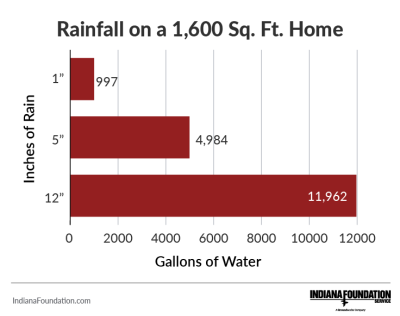
This graph shows just how rapidly rainfall builds up on a typical 1,600 sq. ft. home. One inch of rain results in nearly 1,000 gallons of water. That rapidly advances to almost 5,000 gallons with five inches of rain.
The overall roof structure, starting with total surface area, determines the amount of rainfall volume that accumulates. A steeply pitched roof has more surface area. Plus, the rain moves off the roof much more quickly down that steep slope.
Additionally, wind moves more rain onto the roof, at least on the windward side of the home. Roof hips and valleys can also gather and accelerate the flow of rain into your home’s gutters and drainage system.
Properly Sized Gutter and Downspout Considerations
Here’s a list of factors to consider when calculating gutter and downspout dimensions:
- Anticipated maximum rainfall intensity
- Roof square footage, pitch, and any hip and valley rafters
- Width and shape of gutters (K-style or half-round)
- Slope of the gutters between downspouts
- Downspout number and position, as well as their shape (round or rectangular)
Drainage Calculation for Indianapolis
NOAA states that the most intense five-minute burst of rain that’s likely over a 10-year period for Indianapolis is 0.613 inches, selecting the Indianapolis WSFO AP location. Using that number to calculate inches per hour is then 0.613 x 12, or 7.4 inches.
Let’s start with a home footprint of 850 square feet. With a roof pitch of 8-in-12, the pitch factor is 1.1, which is a 10% increase over a flat roof. That brings the roof watershed to 935 square feet. Multiplying the maximum rainfall intensity for one hour of 7.4 by 935 yields a drainage capacity of 6,919 square feet. That fits within the capacity of a six-inch K-style gutter at 7,960 square feet. The builder will also need to take into consideration the pitch of the gutter, the number of downspouts, as well as their size, shape, and position.
Drainage Away From the Foundation
Gutters and downspouts get the rain off the roof and onto the ground. But the journey should not stop there. With heavy rain, the ground will also be soaked with the water from the roof, pooling up around the foundation.
Critical elements of the drainage system at that point are downspout extensions that move the water away from the basement. Additionally, your home’s landscape should be graded to a slope that moves the water away from the foundation. Installing basement waterproofing solutions greatly limits any chance of flooding.
The Costs of Home Flooding
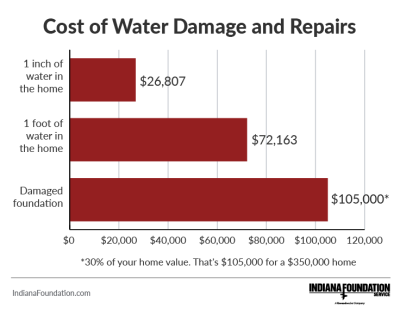
FEMA has developed cost estimates for several different levels of home flooding, which we’ve highlighted in this graph for a 2,500 square-foot single-story home.
These are horrendous numbers to take into account as you consider your home’s gutters, downspouts, and drainage. Getting everything set up correctly to prevent basement flooding can certainly be worth the cost.
Need Waterproofing Help? Trust Indiana Foundation Service
Gutters and downspouts are your first line of defense against a flooded basement. As crucial as it is for these systems to function properly, it’s equally important to have reliable basement waterproofing solutions, from interior drains to sump pumps, protecting your home.
For professional advice on drainage systems for your home, contact your local basement waterproofing experts at Indiana Foundation Service for a free inspection and repair estimate to identify any issues that could lead to home damage.
Drainage FAQs
Water typically enters your basement through cracks in walls or floors, leaking joints, seepage through porous concrete, or internal plumbing or appliance leaks. Improper landscaping or gutters can also direct water towards your foundation.
When it rains, water inevitably finds its way into your basement. Basement leaks occur due to the permeability of basement walls and floors, particularly when the ground is saturated. Another common entry point for water is through the wall-floor joint.
Yes, the slope of the ground around your home should direct water away from the foundation. Poor landscaping can lead to water pooling around your home and increasing the risk of leaks.
Related Resources



Holly Richards-Purpura
Publish Date:
Last Modified Date:
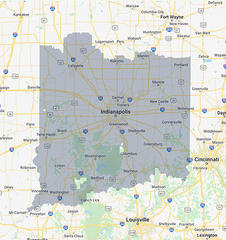
Our Locations
624 North Front Street
Whiteland, IN 46184
2731 Albright Rd
Kokomo, 46902
8 N 3rd St
Lafayette, IN 47901